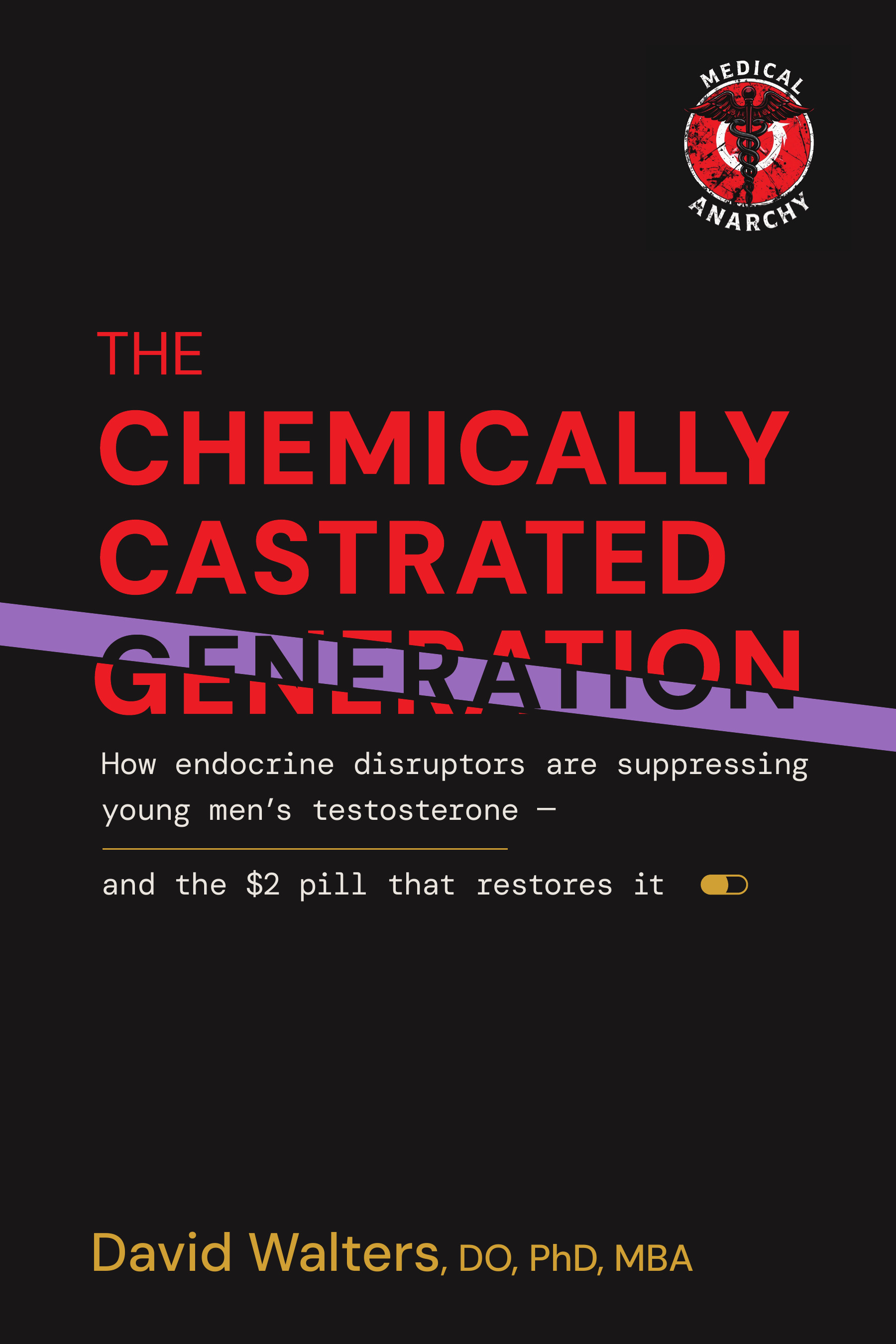
How endocrine disruptors are suppressing young men's testosterone — and the $2 pill that restores it.
Free to read with Kindle Unlimited. Also from Barnes & Noble, Bookshop.org and your local bookstore — all retailers.
For fifteen years I have watched young men walk into my clinic exhausted, flat, and quietly certain that something was wrong with them. Most had already been told they were fine. Most had been handed an antidepressant. Almost none had ever had their testosterone checked.
When I checked it, the number was often lower than their grandfather's.
This book is the case I have spent a career assembling — and it is a clinical case, start to finish. The decline is real. The cause is chemical. And the treatment costs about two dollars a dose.
Testosterone in young American men has fallen by nearly half in four decades. Sperm counts have dropped by more than half. The chemicals driving the decline — the bisphenols, phthalates, and organochlorines that entered the food and water supply at industrial scale beginning in the 1970s — suppress the hormonal signal at the level of the brain, not the testes.
The result is a clinical picture — fatigue, low drive, depression that does not lift with antidepressants — that is being read as primary mental illness, because the framework that would identify the hormonal cause is not taught in most medical schools.
The standard answer, testosterone replacement, makes the underlying problem worse: it suppresses an already-fragile system further. The better answer is a generic medication that has been on pharmacy shelves for half a century, costs about two dollars a dose, and restores a man's own production rather than replacing it. It is called clomiphene citrate — and it may be the most important men's health medication most physicians have never prescribed for this purpose.
This book documents the crisis, names the mechanism, and lays out the treatment.
These young men did not lose their testosterone. In most cases, they never had it in the first place.
Told for years that the way he feels is in his head — when a single blood test, read against the right baseline, would have told a different story.
Into fatigue, lost motivation, and a stack of prescriptions that aren't working — and unable to get a straight answer about why.
And wants the evidence base intact and the clinical reasoning visible — the mechanism, the studies, and the protocol, not a polemic.
Built on 152 peer-reviewed studies — including the work of Swan, Levine, Skakkebæk, Travison, and Lokeshwar — and written so all three can follow it without being talked down to.
Bookstores can order it by ISBN. Listings at other retailers can take a few days longer to appear than Amazon.
Leave your email and I'll tell you the day the book is out — plus the occasional Medical Anarchy dispatch. Unsubscribe anytime.
Yes. The Kindle edition is enrolled in Kindle Unlimited, so members can read it at no extra cost.
Not yet. An audiobook is planned after the paperback is out. Join the launch-day email list above to hear when it's available.
No. It was written so a motivated reader with no medical training can follow the argument from first principles to clinical action — while keeping the evidence intact for physicians.
Only if you want to. The book explains the reasoning behind the approach used in the clinic, but your care doesn't depend on it. Questions about your own treatment belong in a visit, not a book.
No. The book is an informational resource. Do not start, stop or change any medication based on it without talking to your own physician.
David Walters has spent twenty-five years restoring hormonal function in men and women. He began his scientific career in reproductive endocrinology — his research demonstrated that the ovary produces oxytocin, a finding that contradicted the medical teaching of the time — and entered medical school at forty, after turning around a failing rural hospital as its administrator. He writes the Medical Anarchy Substack and practices in South Dakota and Colorado.
This page describes a book and is provided for informational purposes only. Nothing here constitutes medical advice or establishes a physician–patient relationship.